
Looking around the circle, I could see the frustration and hopelessness on my peers' faces. During this 'Consejo de Curso,' a block class once a week devoted to discussion of our concerns about schoolwork and personal issues, we turned to the controversial topic of education.
Facing the difficult questions and the hard truth
The day before, the majority of the class - including myself - had gone to a forum on education hosted by TECHO, a Latin American volunteer organization that focuses on social consciousness, promotion of social changes, and service especially among young persons working with the affected community to overcome widespread poberty. There, we met with around eight other mostly private schools to learn and discuss the social stratification of the education system (i.e. how the best-performing schools are private schools located in the northwest region of Santiago that is the richest part of the country) and its contribution to Chile's enduring poverty (i.e. how the unfair access to a quality education greatly affects the students' overall performance and ability to enter into a university that will prepare them for a stable, high-earning career).

Photo Credit: Cesar Rivera
("Public Education on Sale")
We also talked about the lack of diversity in general of Chilean schools. This diversity is lacking on all levels including socioeconomic and sexual, to name a few. The organizers, ranging from university-aged students to young professionals, showed us the above graph to distinguish exclusion, segregation, integration, and inclusion. I found the message of the infographic to be very striking when we divided into groups representing a mix of high schools to write down ideas on how we as students (not the government or other authority figures) could do to improve the Chilean educational system.

Photo Credit: BBC Mundo
(Left: "There is not bread...to study" and "Education is a right NOT a privilege")
Currently, there is a profound segregation among the socioeconomic classes about the quality of education. The basic principle is that private schools are - by a long shot - the best chance to have a solid education. The other types of schools, the particular semi-private school partially funded by the government and the public school wholly funded by the government. They deliver a sub-par education, in part because there is a lack of resources, organization, and teachers (the teacher-student ratio is something outrageous like 50:1). As a result, those who come from poor backgrounds have a lower chance to change their socioeconomic status because they do not receive a solid educational basis. It is unfair, to say the least. The following pdf with a list of high schools and their average test scores demonstrates a stark parallel between the amount of money paid for school and the test results: http://webcache.googleusercontent.com/search?q=cache:c5EIOKoIwJUJ:admisionyregistros.uc.cl/component/docman/doc_download/2391-ranking-psu-2014%3FItemid%3D+&cd=4&hl=en&ct=clnk&gl=cl
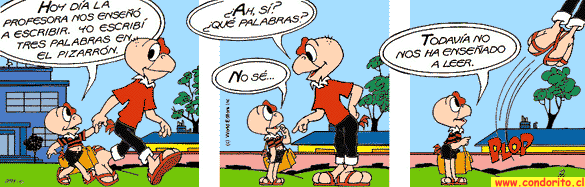
Photo Credit: leerbook.blogspot.com
(From Condorito, a Chilean-originated Latin American comic book series of more than 64 years. First frame: "Today the teacher taught us to write. I wrote three words on the board."
Second frame: "Oy, yeah? What words?" -"I don't know..."
Third frame: "The teacher still hasn't taught us to read.")
Inclusion is ultimately what Chileans (and I would argue every person, regardless of country of origin) want to achieve, where classrooms have a mix of students coming from different backgrounds, the class sizes are small to have focused teacher-student interaction, and the quality of education is solid for every person. But how can Chile go from segregation to inclusion? Ultimately, we grappled with this both within ourselves and within our group. Some thought of the idea of mandating service days each month to go out into the community and do service to see another socioeconomic situation. But would that be a good long-term solution to a bigger educational program?
.jpg/230px-Logo_del_Ministerio_de_Educaci%C3%B3n_(Chile).jpg)
Photo Credit: Wikipedia
Some voiced the idea to have the government begin a program to bus students from poorer regions to the richer regions with better schools and vice versa to diversify the student population. This would basically be integration as a means towards inclusion (very much resembling the earlier US attempts to desegregate schools, like Little Rock Nine, and the Chilean attempt se). Again, would this serve as a long-term solution? What would be the social and economic implications? Overall, this was an incredibly difficult activity to do.
We felt that there was so much to be done but so little that we could do as individuals. The qualities that most people seek in these discussions are a free and good public educational system (which would require more government investment towards the right places), more and better quality professors, more diversity, and smaller teacher-student ratios. After all, a well-educated future generation would produce significant natural capital.
But there have been countless barriers towards this ideal. For one, the students are held within a private school system that works very very well so do not feel as great an obligation from experience to improve the overall system. One female student in a forum I attended stated during the Q-and-A session that she did not believe that there was a problem with the educational system. Many parents also oppose the idea of introducing inclusion to schools because they do not want their children interacting with other classes (there is much classism present in the society and rarely does one interact with people of other classes). The question always reverts to a frustrated and angry response: what can we, as students, do about this system? There never appears to be a clear-cut way to better the system (but that is probably because such a solution is nonexistent).

(Above: Photo Credit - The Atlantic)
(Left: "Chilean students exiled against education of the [economic] market")
(Right: "No to Chilean educational exile")
Protests and Debate
The topic of the Chilean educational system permeates in every social environment to which I have been exposed. The news features news about a student march or teacher's protest (there was even a teacher's march about their wages this past week and I encountered a student protest on my way home the other day) almost every two weeks, the US Embassy sends me constant notices about protest dates and locations to avoid for safety reasons, we discuss and debate the system as regular conversation topics during class and private conversations (my friends and I even talked about it during my birthday celebration), and there are many public events to discuss ideas for reform among many groups of people. In just three months, I have gone to a city-hall type event with a forum of politicians, protest organizers, and students for an audience of the residents of the region ranging from middle school students to adults and the TECHO forum with high school students described above. Public discussion about this controversial topic occurs everywhere, and I admire that a lot. The educational system in the US is not-so-great, either, but it does not permeate the social atmosphere as much and, thus, there is an even lower chance of improving the system.

Photo Credit: Brittany Peterson
(Meaning: "Education and Health is the best investment that a society can make")
Everyone agrees that the system is bad and dysfunctional, but they disagree about what to do about it. This conversation has gone on for a significant amount of time. Notably, the 2006 student protests in Chile, also known as the March of the Penguins (so-called because of the black/blue-white students' uniforms) carried out across Chile with nearly 800,000 student participants demonstrated the pressing need to reform education. Although President Bachelet has introduced some educational reforms as a result, they are moderate and have not truly influenced the educational landscape.
Overall, this is an ongoing and sometimes very painful subject for me to hear about. We can see how the system is failing the students and the next generation, but it is difficult to imagine and take the risky steps to improve it.

Photo Credit: ilovechile.cl
The 101 of the Chilean Educational System
Disclaimer: I will try to generalize here, but remember that I am speaking from personal experience attending a private school in Santiago. The schooling experience is certainly different in other cities in other types of schools. Even within private schools, there are differences, especially with their attitude towards students' academic achievement (some highly prize it and prioritize having their students achieve the highest test-scores, while others, like my own school, teach for high test scores but in a more relaxed atmosphere).
School Year and Grades
Since Chile is in the Southern Hemisphere, the seasons are the opposite of the US's schooling season. Thus, the school year begins in March and ends in mid-December. The last two weeks of school in December are devoted to final exams.
On another note, the grades are on a scale of 2 (being an F) to 7 (being an A+, which is very difficult to achieve). The scale is odd and appears exponential; I still do not understand it completely. The general idea, though, is that a grade of 6,5 (commas are used for decimal placement, and periods are used where commas are used traditionally in the US) is good. If you'd like to take a look, this is what the professors use to grade: http://escaladenotas.cl/
There are about eight grades per semester, with heavy weighting for tests and projects with no weighting for homework assignments (especially because daily assignments, aside from math exercises, do not exist at my school). These grades are individually averages. For example, one of the eight grades may be for the first two books we read in Spanish Literature and Grammar class. We did a test for the first book and a roundtable panel-like discussion for the second book; the average of the two grades was a single grade in the book. At the end of the semester, the grades are averaged. If students achieve a 6,5 average or higher for the year, they are "eximidos" or excused from taking the final exam. This is a relatively rare situation; my friends have told me that in all the years they have been in school, only one classmate of the class has been excused from final exams each year.

Preschool to High School
The schooling system is organized into three obligatory periods: preescolar (preschool), enseñanza basica (first grade to eighth grade called "primer básico" to "octavo básico," respectively), and enseñanza media (ninth grade to twelfth grade, called "primer medio" to "cuarto medio," respectively). It is highly rare for students to skip grades. All students in Chile have the same educational standards and government program; the textbooks are written by the government. In tercer and cuarto medio (the equivalent of eleventh and twelfth grades), the educational program is differentiated according to specialty (a sciences or humanities route).
Uniforms
In general, Chilean students wear uniforms to eliminate the social and economic pressure of clothing choice. Although it depends on the school, girls wear a button down shirt or collared polo shirt with a dark colored skirt or, like me, wear a long-sleeved button down shirt with a stiff knee-long dress (called a jumper) on top with knee-high dark-colored socks and Mary Jane black shoes. The insignia of the school is displayed prominently on the chest of the uniform. Also, some schools require a tie but mine does not.

Photo Credit: fotolog.com
Males wear khaki pants in either gray, dark blue, or black, and a button down shirt or polo shirt with black dress shoes. For physical education classes (which is mandatory in all grades up until segundo medio in my school), students wear a short sleeved shirt with the school logo in front and a "buso," long gym pants made of thick cotton. Other school rules include not painting one's nails and wearing long earrings (only ones attached closely to the ear are allowed). Jackets must be black or blue and have no school logo. Having a strict uniform has not been a difficult change for me. I like not having to choose what to wear every day, but sometimes it is uncomfortable and hot having to wear the same long-sleeved outfit every day. It also makes it a celebration to have jeans or no-uniform days because everyone donates to the cause to participate and then dresses in their best outfit and takes pictures for the special day.
One Classroom
Instead of going to a different classroom for each period, we stay in a group of twenty-something students (a normal number for private schools, but about half the normal class size for public schools) all day, every day, and the teachers come the class to teach us. It makes it more difficult to meet new people but also develops very close ties with the class. By being together so much and given the fact that most have known each other since kindergarten, we know practically everything that has happened to each other, our weird habits, etc.
Teaching Style
Lastly, the teaching style is best characterized as traditional. Textbooks are heavily used in each subject area and tests - few in number - are given after each unit as the main indicator of comprehension. The teacher usually lectures while writing some notes on the board or uses PowerPoint as an aid. My teachers are very friendly and are always willing to answer questions. Most importantly, students in my class feel comfortable around the teacher; they tell the professor about their day, their problems, and connect their experiences with what is being learned (e.g. in biology class, we are learning about genetics, which has sparked many in-class discussions about students' genetic history and what it means for their parents to be blood type B, etc.)
What I Appreciate and Admire
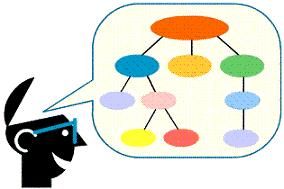
My school has two notable teaching aspects that I appreciate. First, work in groups in 'trabajos' are greatly encouraged. There is about as many projects in the form of posters or PowerPoints as tests. Although they take much time and creativity, they help with public speaking and teamwork. The second part is the use of conceptual maps. Teachers write their notes on the board and students have projects and notes with conceptual maps, indicating broad concepts and connecting them to smaller, more detailed concepts. I think that I will continue to bring this practice with me to university because I like how it allows me to take a step back from the very detailed information being taught and organize it in a logical format based on information I already learned. It reinforces knowledge; after all, the brain remembers more when it makes connections.
PSU: The Source of Stress for Many
Mention the word PSU on any given day and a Chilean student will groan. This is a Chilean national standardized university admissions test that stands for "Prueba de Seleccion Universitaria" ("Test of University Selection") administered at the end of one's fourth year of high school. The points for this multiple-choice test, along with the accumulation of grades in one's high school career, form a number of points. These points are then calculated along with the ranking for a final score, which the universities use to admit students.

Photo Credit: Wikipedia
(Catholic University of Chile, the most prestigious of the country and among one of the 500 best in the world)
In virtually every country in the world except the US, the university system is more specialized; one enters university with a vocational decision. Thus, the number of points determine the career one can have. The highest scores allow for one to study to be a doctor (with a duration of seven years) while the lowest allow for one to be a teacher (which is one reason why the school system is horrendous). The Catholic University of Chile is the most prestigious (virtually every Chilean student dreams to go there) and the University of Chile is the second most prestigious. In the words of most students I have spoken to, "one needs to get into a good university to get a good job." Also, those with the highest scores in the country (i.e. received nearly perfect or perfect scores) meet the president.
The PSU is divided into four tests. Two of these tests, mathematics and Spanish language, are obligatory, while there are two electives. These electives are "History and Social Sciences" and "Sciences" (a mix of the first two years of high school physics, chemistry, and biology, and the last two years of one's choice of the three sciences). My classmates in the second year of high school are in the process of choosing their electives. For the first time in their lives, they will be taking classes with students not from their immediate classroom. 60% of classes next year will be general classes like Language and Mathematics that will cover PSU topics.

Photo Credit: Blogspot.com
(Newspaper Article: "What to Study at the Last Hour to not Fail in the PSU")
The four other classes are considered differentiated classes, a concept which is mandated in Decree 220 (Decreto 220) of Chilean law. The first step is to determine that, in addition to taking the obligatory PSU of math and language, if they will take the History or Science PSU. It greatly depends on the students' vocational plan. For example, if they are trying to enter medical school, only the PSU Science is accepted. Thus, it is a time to weigh their abilities, interests, and future plans. As a result, ten hours will be devoted next year to the History/Sciences PSU and there will be three electives, the first and second of which are three hours each (three classes each) and the third called "Transversal" that is two hours (two classes each).
For example, the distribution varies depending on the individual's choice of a sciences or humanities direction. If one plans to take the Science PSU, the distribution of history and sciences (physics, chemistry, and biology) is 4 hours-6 hours, while the History PSU translates to a course distribution of 6 hours history, 2 hours biology, and 2 hours of applied sciences. These numbers cover the minimum number to cover content in the PSU. (Yes, every part of the curriculum is geared towards preparation for the test, with practice PSU sections at the end of each unit, even.) As a respite from PSU-geared classes, the third elective allows for exploration of a possible unrelated interest, like theater, English, and Physical Education and Health. What a tough curriculum!

Photo Credit: El Naveghable
The overall sentiment of my classmates toward the Chilean university admissions system is that they would rather it be less focused on grades and "more American." I am not sure what I think about this. On the one hand, I think that it is great that the US system tries to look at students more holistically, considering not only the SAT/ACT standardized exams but also the student's essay-writing and extra-curricular activities. The downside to this system is that it is all too common for students to overwork themselves or do activities they do not necessarily like to have it appear "impressive" on the college resume.

Photo Credit: New York Times
Meanwhile, the Chilean system focuses almost exclusively on test performance. The advantage is students choose to do the activities that inspire them, many learn more for the long-term because the cumulative information appears on the PSU, and they must choose their career path relatively early (which eradicates a few years of American college angst about vocational plans). However, I find that the system takes away much of the joy and art of learning and teaching because teachers teach for the test and students learn, memorize, and stress for the PSU for which they spend their entire senior year studying. If one performs badly, one can retake it in a year but, honestly speaking, bad test-takers have a much lower chance of entering into a career that interests them, a university that they desire, and achieving happiness in their future. These are both imperfect system, understandable because they try to quantify qualitative human characteristics and abilities.

Unique Aspects of School
Convivencia is a term describing a small celebration. We apply it at school every time there is someone's birthday or a special day like Professor's Day. This day, everyone brings something to contribute, including sodas, cookies, cake, and ingredients to make grilled cheese sandwiches (bread, cheese, and a griller). Then, we join all the individual tables together, put a tablecloth on the table, sing happy birthday and give gifts, and eat lots and lots while joking and playing games. It definitely brings us closer and shows the Chilean festive spirit.
CODECU, what students call short for "Consejo de Curso" (meaning "Advice for the Class"), is a time every week to talk with the "Profesor Jefe" (or Chief Professor) who serves as an advisor for the class about worries and problems. The president of the class leads organizational planning for upcoming events, like Convivencia. This is a time to relax and reflect about our academic and personal situations. We usually do not have any pressing problems so it is most often a nice time to talk as a group and finish up homework.
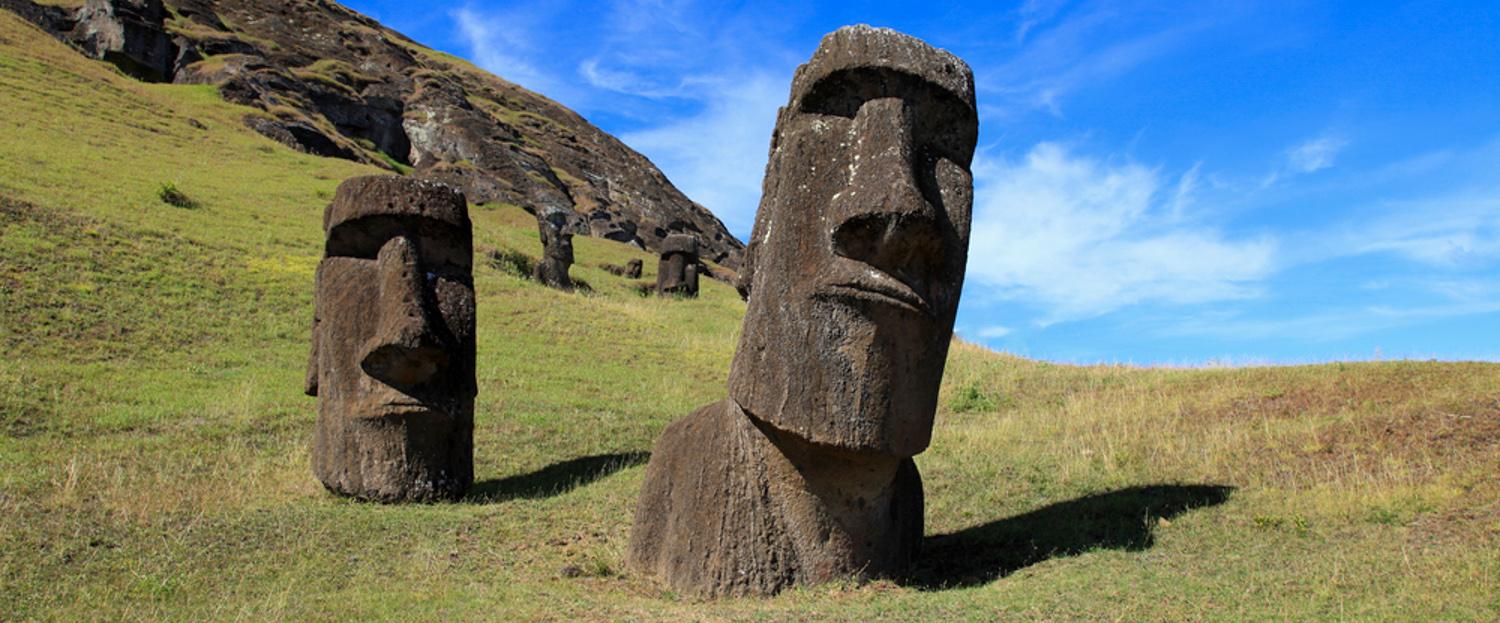
Photo Credit: Zicasso
(Easter Island)
Viaje de Estudio (meaning "Study Trip") is a Chilean practice where students in the tercer medio choose and fundraise for a trip as a class. Other schools allow students to choose destinations outside of Chile; my own school has a policy of destinations within Chile so that students can better know their own country. Parents, students, and professors are active in this process. Students in my class this year are planning from their trip the following year. They proposed, debated, and voted on destinations, and sold sweets and baked goods around the school to fundraise. Parents have contributed by volunteering to accompany students on the trip and plan the specific details and itinerary. Meanwhile, professors have talked about their own experiences in these destinations. Ultimately, the class will decide on two professors to accompany them on the five-day adventure next September. It is too bad that I will not be with them!
With two months left in this quickly fading experience, I am beyond happy and appreciative to have been able to be exposed to a completely new schooling environment and reflect about my own learning style.
Ciao!
Ciao!
Update 13 Nov 2014: I continue being amazed by my classmates' forthrightness and desire for Chile to improve its educational system. Just today, during language class, the subjectiveness of our final practice exams (which are questions from the PSU years before) caused much frustration. They are a series of analytical questions to passages of literature and can have multiple answers. It sparked a class discussion between students and our professor. The students repeatedly expressed their dislike of the continous use of practice tests (we take a PSU practice test for every grammer unit we cover) and the teacher even admitted that it is "bad" that the PSU is the "only instrument that exists" to gauge student aptitude. From a teacher's point-of-view, she said that chile requires much content (information) to be taught, which is a factor for why there is less time that can be devoted to analyzing and developing better methodology and time for teaching students critical thinking skills. We even repeated the common theme of the vicious cycle that lies Chilean educational reform; while there are clearly visible problems, there are barriers, like the high cost of textbooks, the tendency for Chilean parents to focus from the beginning on PSU success and great English skills for their students, and the heavy reliance on the PSU, ranking system, and test scores and grades. It is an immense pity to see such frustration, anger, and a giving-up attitude in my peers. They want to learn and have fun but, in many ways, the school system is removing much of the joy of learning from the experience and colors their overall disposition, especially as we are entering into the two weeks of final exams.

.JPG)
.JPG)

.JPG)

.JPG)

.JPG)

.JPG)
.JPG)
.JPG)
.JPG)
.JPG)
.JPG)
.JPG)
.JPG)

.JPG)
.JPG)
.JPG)


